

One God, Many Religions

Biotechnology and the Ethics of Creation in Islam: A Balance between Science and Divine Stewardship
May 1, 2025
Muslim Brotherhood in France
May 23, 2025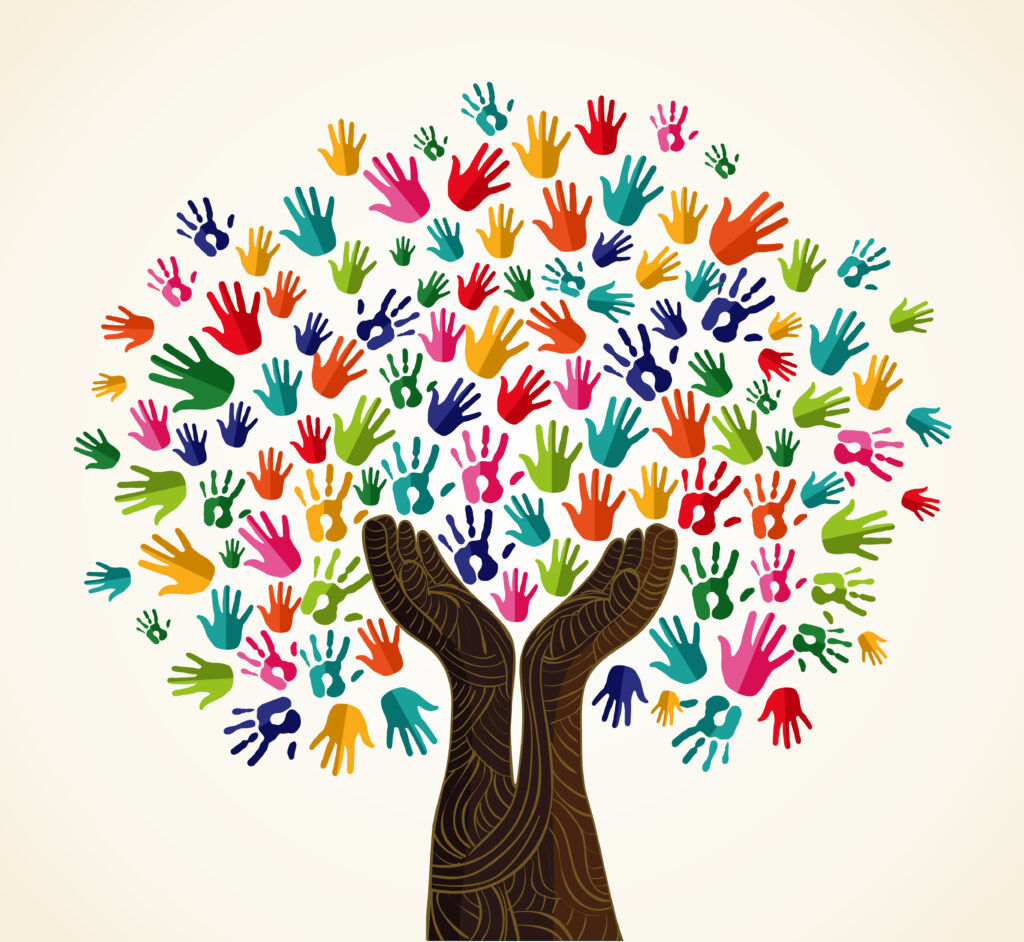
The beauty of diversity
Religious diversity is an expression of the divine design, a natural phenomenon that invites us to embrace acceptance and to promote dialogue between cultures and faiths. Each religion, in its uniqueness, represents a path towards goodness and an act of devotion to God. The differences between faiths should not be perceived as a reason for division, but as a valuable opportunity to enrich mutual understanding and foster the spiritual growth of all humanity.
…
Human diversity: a natural law (Sunnatullah)
It is undeniable that the Earth represents the only habitat for humanity; yet it is an immutable divine law (Sunnatullah – سُنَّةُ الله) that its inhabitants are distinguished by tribes, ethnicities, languages, professions, cultures, and different faiths. This plurality is not a historical accident, but rather an intrinsic phenomenon of creation, rooted in divine will.
Diversity manifests at every level of society. It ranges from macro-differences between nations to micro-dynamics within families, where differing views and beliefs can coexist even within the same household.
Every nation has a different law compared to that of other nations. If Allah had wanted, He would have created a single nation with one law. Indeed, Allah commands His servants to worship one religion, that is to submit to Him. However, to achieve this goal, Allah has established different paths and has instituted various sunnah for His servants, based on their differences, readiness, and diversity. Furthermore, Allah has created different laws to test the faith of men.
There are the law of the Prophet Muhammad, the law of the Prophet Noah, Abraham, Moses, Jesus, and others.
Religion is one, while the law is always different.
Al-dīn wāḥid wa al-sharī’ah mukhtalifah.
It is therefore appropriate for each people not to question the differences in laws. Rather, what is necessary is to find as many common points as possible among different peoples. People are called to respect and even study previous laws. For every human being, a path to the Truth, shari’ah, and a method of implementation, minhaj, have been established. If God had wanted, He would have made humanity one unique nation. However, God intends to test us with what He has given us.
So, compete in doing good. Ultimately, we will all return to God, and it will be then that He will explain to us what we disagreed upon.
The will of God in Diversity
It is clear that God desires His creatures to differ not only in physical reality, but also in ideas, concepts, beliefs, and religions. This is highlighted in various verses of the Quran, including:
And if your Lord had willed, He would have made mankind one community. But they will continue to disagree.
“And if your Lord had wished, He would have made mankind one community. But they continue to be in conflict with one another” (Quran, Hud, 11:118).
Thus, it is evident that diversity in religions and faiths is not contrary to God's will. In another well-known verse, it is stated:
There is no compulsion in religion; the right course has become distinct from the wrong.
"There should be no compulsion in religion, for the right way has become distinct from the wrong" (Quran, Al-Baqara, 2:256).
This verse indicates that not only is there no compulsion for anyone to embrace a religion or change it, but that people are also free to choose not to have any religion. Since God has clearly indicated the right and wrong paths, it is up to each individual to choose, of course with all the consequences.
Religious faith is the most personal, exclusive, and hidden part of a human being, and therefore no power outside of that of God can compel a person to believe. No one can force someone to follow their teachings. As the Quran states:
لَـسۡتَ عَلَيۡهِمۡ بِمُصَۜيۡطِرٍۙ
“You are not the one who can control them” (Quran, Al-Ghasiyyah, 88:22).
The Final Judgment belongs to God.
وَلَوْ شَآءَ رَبُّكَ لَءَامَنَ مَن فِى ٱلْأَرْضِ كُلُّهُمْ جَمِيعًا ۚ أَفَأَنتَ تُكْرِهُ ٱلنَّاسَ حَتَّىٰ يَكُونُوا۟ مُؤْمِنِينَ
“E se il tuo Signore avesse voluto, tutti coloro che sono sulla terra avrebbero creduto. Ma tu (vuoi forse) forzare le persone a diventare credenti?” (Corano, Yunus, 10:99).
Only God knows. And it is only Him who decides whether each person's faith is right or wrong on the Day of Judgment. It is therefore clear that, as religious people, we must accept diversity. God created human beings in diversity, and this diversity is not meant to destroy each other, but so that people can know each other, dialogue, and appreciate each other's existence.
Religion as a Means
With the revelation of various religions, God does not justify discrimination against one people over another, but invites everyone to compete in doing good. Religion is not an end, but a means that leads the faithful towards God.
The nobility of human beings before God is evaluated based on their goodness and sincerity in fulfilling good deeds. Therefore, every follower of a religion should develop an appropriate view regarding the existence of their faith in relation to others. It is essential that each person is aware of the differences between their own religion and those of others, and that these differences are considered a blessing for the universe.
Accepting Differences Embracing Diversity
We are all brothers and sisters of the same faith. We should always be united in tawhid (the Unicity of God). And no creature of any kind is able to separate our unity except the diseases of our hearts and our inner murkiness, مرض في قلوبنا “Disease in our hearts.”
However, we may not agree. We do not have the same understanding. We do not concur. We do not follow the same current and we do not have the same beliefs. Our brothers and sisters adhere to this and we adhere to that. Our other brothers and sisters may adhere to a certain school of thought based on their nature of birth and perhaps their cultural background. Therefore, we should be able to confront each other, and the results of such confrontation may be partly decided as a unanimous agreement, but we may have to allow others to differ.
We are also free to judge each other, to criticize one another, and perhaps to evaluate each other reciprocally, but the most important thing we must always remember is that the act of judgment should be based on the awareness of the limits and relativity of our abilities as imperfect creatures. The rest is a non-negotiable belief that Allah is Omnipotent and capable of executing the final judgment.
اَلَيْسَ اللّٰهُ بِاَحْكَمِ الْحٰكِمِينَ - Isn't Allah the best of judges?
It is so, brothers and sisters, that perhaps we do not agree, we do not share the same beliefs, there is no need to worry about this and there is no need to be distressed.
First of all, we often hear that a thousand heads have a thousand opinions. When Allah says in Surah Al-Hujurat verse 13:
يٰٓاَيُّهَا النَّاسُ اِنَّا خَلَقْنٰكُمْ مِّنْ ذَكَرٍ وَّاُنْثٰى وَجَعَلْنٰكُمْ شُعُوْبًا وَّقَبَاۤىِٕلَ لِتَعَارَفُوْاۚ اِنَّ اَكْرَمَكُمْ عِنْدَ اللّٰهِ اَتْقٰىكُمْۗ اِنَّ اللّٰهَ عَلِيْمٌ خَبِيْرٌ
“O mankind, indeed We have created you from a male and a female. And We made you peoples and tribes that you may know one another. Indeed, the most noble of you in the sight of Allah is the most righteous of you. Indeed, Allah is Knowing and Acquainted.”
“And We made you peoples and tribes so that you may know one another...” I believe it is not only about the differences between nations, skin colors, tribes, languages, and beliefs, but also about the analogies and the connotations that these differences carry.
Furthermore, why did Allah create various forms of design for all parts of our body that have their own uniqueness?
That is, in addition to different nations, tribes, and languages, they always have their own uniqueness that distinguishes our nature of life, our way of thinking, or certain psychological habits, and of course, there is a broader understanding, that is, thoughts that reflect different religious internalizations.
The Differences as a Blessing and the Necessity of Humility
Getting to Know Each Other and Understanding Each Other
Among the differences that characterize us, we are advised by the principle of "lita’aarofu", which means to get to know each other reciprocally. This means understanding others, giving each other space, and practicing tolerance, as long as these differences do not concern the fundamental principles of faith. However, the ultimate and most important goal remains to know the Great Creator, Allah ﷻ.
Some differences can be a subject of dialogue and negotiation, leading us to mutual understanding. Others, however, cannot be resolved and must simply be accepted in their diversity.
Differences are not Authoritarianism.
I firmly believe that these diversities of thought or trend do not stem from an intentional desire to impose authority over others. Rather, they often represent an expression of the human instinct to protect oneself or one's community. The "self" – with all its beliefs and understandings – feels the need to be defended. However, the problem arises when it is demanded that everyone thinks the same way. Instead, we must accept that, even if no one shares our ideas, we still have the right to live according to our convictions.
Avoiding Arrogance in Divergences
Sometimes, our brothers and sisters feel defeated when others disagree with them. This feeling of defeat can manifest in their words, as if what is being rejected is the very truth of Islam. Consequently, those who do not agree with them are considered to have violated Islamic principles or even labeled as infidels. This attitude reduces Islam to an inanimate object, devoid of its universal values.
A Mosaic of Riches
Instead, we should create space and energy to imagine that different people, with different living conditions, if nourished by Islam – understood as total submission to the Creator of this universe – can form a mosaic of unlimited richness. A mosaic as beautiful as those of the city of Rome, which reflects a spark of Allah's ﷻ infinite richness, which we can never fully comprehend. We must prepare to be humble, aware of our shared limitations, knowing that we see and understand only a small part of this mosaic.
Surrendering to Allah in the Face of Chaos
If confusion and chaos persist, we can still surrender to Him. Indeed, Allah is the All-Knowing, the One who knows everything. Therefore, we should not overly worry about the differences of opinion among us. Instead, we must continue to strive so that these differences become what Allah desires: a blessing, not a disaster.
The Vastness of the Truth of Islam.
I think the essence of it all is our shared awareness that the lives of all God's creatures are moving towards identification with the truth of Islam. However, the form of our personal truth does not coincide with the absolute Truth of Islam. The Truth of Islam is immense, as vast as the universe He has created, and we, in our smallness, are simply joining it.
Cultivating a Muslim Personality with Humility.
To cultivate a Muslim personality does not mean to fall into egocentrism, absorbing Islam as if we ourselves were its total embodiment. This would be arrogance. Even though, in reality, we are no more important than a particle (Dharrah) in the vastness of creation.
If we were created to be caliphs on this earth, our caliphate must be imbued with humility and awareness of our spiritual poverty before Allah ﷻ.
The Limits of Human Knowledge
No one can fully reach or comprehend Allah ﷻ. At most, we can have our own personal perception of Him. Allah's horizons are infinite, His "Sirāt al-Mustaqīm" (straight path) can never be fully explored. Everything our minds and hearts can say about Allah ﷻ is limited to the relativity of our knowledge and personal experiences. We cannot calculate how much His richness surpasses our smallness, which often manifests in arrogance. For this reason, we have no other choice but sincere humility. And this is the best thing.
Yusuf Daud (Traduzione a cura della Redazione)