

The Tayammum in Islam

The 'Coran Law' approved in Denmark.
December 9, 2023
The joint operation between Spain and Morocco leads to the arrest of ISIS cells
December 20, 2023The use of Tayammum as an alternative to ablution with water in Islam, its conditions, and its spiritual significance according to the Quran and Sunnah.
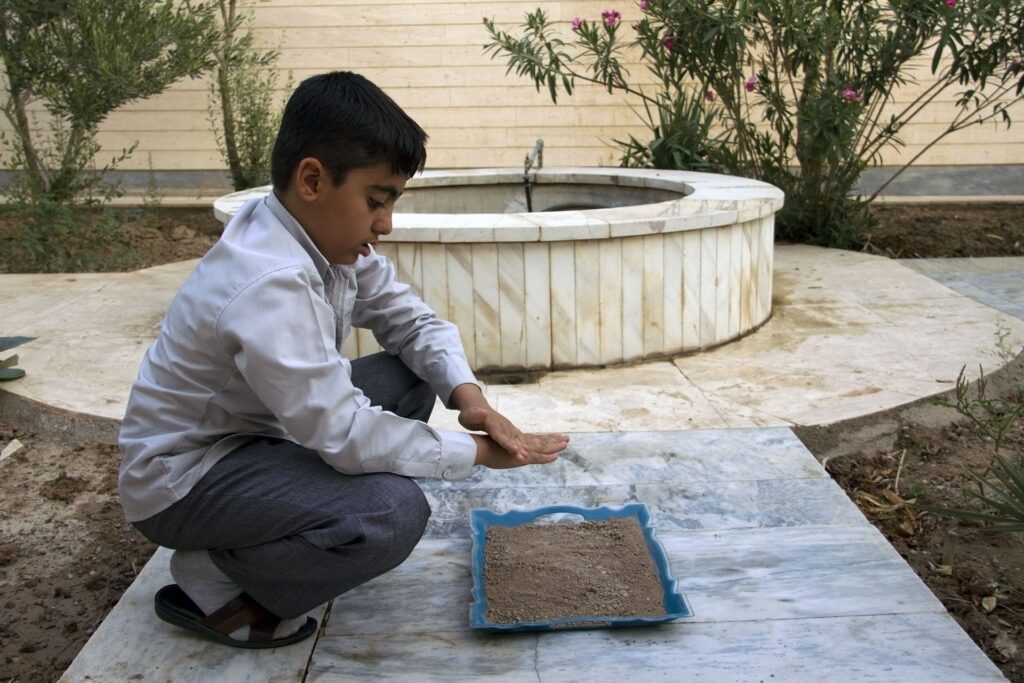
Tayammum consists of purifying oneself with clean sand or clean earth [free from Najis], and it replaces the use of water in case of its unavailability. It is equivalent to ablution [with water] before performing both voluntary and obligatory prayers, past and future, provided that a state of purity is maintained. Tayammum can also replace the use of water in performing Ghusl (full-body ritual washing) from impurities, ensuring a level of purity equivalent to that achieved with wudhu (ablution). The reason Tayammum can replace water in removing impurity lies in the fact that the Messenger of Allah ﷺ considered the earth as pure. The Prophet ﷺ stated: “The earth has been made for me a place of worship and a means of purification.” [Sunan An-Nasāʾī].
Purification [in this regard] is what purifies. The land is pure, just as water is pure. If the conditions are met, it is permissible for Tayammum, In another hadith the Messenger ﷺ said: “Clean soil is the ablution of a Muslim, even if he does not find water for ten years.” So, the Messenger ﷺ called it ablution, and ablution is what removes impurity. Tayammum is hence a purification that removes impurity, and if impurity is removed, then it does not return except for its causes, which are known nullifiers.
Conditions
When we make ritual washing, we need water. When we cannot find water to perform ablution [wuḍūʾ] with or to perform Ghusl, we are taught as a gift to do Tayammum, the dry ritual purification using purified [clean] sand or stone or mud.
Tayammum is permissible when there is a problem that prevents a Muslim from using water such as illness, severe cold, etc. Tayammum, subject to such conditions, is permissible when traveling or at home. Tayammum is permissible for those who go out in the wilderness on spring break and the like. They are allowed to perform tayammum due to lack of water or extreme cold, given that they ride from outside the city they spend a number of days in the wilderness. But if they have the facility to heat the water, then tayammum will not be valid. It is very important therefore, to look into the situation, evaluate and find out whether it is a reasonable hardship, or not, because the situation is between you and Allāh ﷻ The permissibility of Tayammum has been proven by the Qur’an, Sunnah, and consensus: From the Book is the Almighty’s saying: “But if you are ill, or are travelling, or have just satisfied a want of nature, or have cohabited with a woman, and can find no water then [perform tayammum] resort to pure dust, passing [therewith] lightly over your face and your hands. Behold, God is indeed an absolver of sins, much-forgiving”. [An-Nisāʾ: 43]
– وإن كنتم مرضى أو على سفر أو جاء أحد منكم من الغائط أو لامستم النساء فلم تجدوا ماء فتيمموا صعيدا طيبا فامسحوا بوجوهكم وأيديكم إن الله كان عفوا غفورا
Among the Sunnah: It was narrated that Jābir ibn ʿAbd Allāh reported, that the Messenger of Allāh ﷺ said: “The earth has been made for me a place of prostration and a means of purification, so wherever a man of my Ummah is, when the time for prayer comes, let him pray." [Sunan an-Nasa'i]
جُعِلَتْ لِيَ الأَرْضُ مَسْجِدًا وَطَهُورًا أَيْنَمَا أَدْرَكَ رَجُلٌ مِنْ أُمَّتِي الصَّلاَةَ صَلَّى
And by consensus: Muslims unanimously agreed that tayammum is permissible, instead of ablution, and washing [Ghusl] but in special circumstances and under certain conditions.
وقد أجمع المسلمون على أن التيمم مشروع بدلا عن الوضوء والغسل لكن في أحوال خاصة وبشروط معينة
The disappearance of what is permissible for tayammum, invalidates Tayammum
When Tayammum is invalidated, on the one hand, it is necessary for one to perform either ablution or Ghusl depending on the nature of impurity and reason that they had performed tayammum for. If they performed tayammum due to impurity that requires Ghusl, and during the lack of water, then they find water, they must perform ghusl to purify even if the impurity does not renew. And if the impurity was requiring only ablution, in order to pray, they have to perform ablution when water is found.
On the other hand, if the reason for which tayammum due to impurity was performed because of illness for example, and then they recover from the illness, they must perform Ghusl and/or ablution accordingly as mentioned above.
There is hence no difference between tayammum instead of ablution and tayammum instead of Ghusl, other than the intention you have to make for either the ritual impurity or for the minor impurity [ablution], or both. This, because tayammum is a branch of independent purity, not an origin to be attached to it. What is intended from it is to show devotion to the Almighty God.
In the same regard, if one performs tayammum due to either impurity, they remain pure and do not repeat the tayammum for every prayer, unless they become impure a second time, in which case they repeat Tayammum for this last impurity. Furthermore, the expiration of the time does not invalidate the tayammum. If you performed tayammum for the noon prayer, for example, and continued in purity until the afternoon time entered, you remain in purity and there is no blame on you.
Allāh ﷻ said after mentioning tayammum: “God does not want to place any hardship on you, but He wants to purify you and to complete His blessings upon you that you may be grateful.”
Whoever is not able to do Ghusl because he is sick and/or fears severe cold may do tayammum instead and he does not have to repeat or delay his prayers. The evidence of this is derived from several Hadiths; from the hadith of ‘Amr ibn al- ‘Aas reported by Abū Dāwūd, and from the hadith that was narrated by `Imran bin Husain Al-Khuza`I, and the hadith reported by Jābir ibn ʿAbd Allāh [may Allāh be pleased with them all].
- o ‘Amr ibn al- ‘Aas [may God be pleased with him] said: “I had a wet dream on a cold night during the campaign of Dhāt al-Salāsil, and I was scared that if I did Ghusl I might die. So, I did Tayammum and prayed, then in the morning my companions mentioned that to the Prophet ﷺ. He said, ‘O ‘Amr, you led your companions in prayer when you were junub.’ I told him what had kept me from doing Ghusl and I said, ‘I heard that Allāh says: “And do not kill yourselves. Surely, Allāh is Most Merciful to you”
وَلَا تَقْتُلُوا أَنْفُسَكُمْ إِنَّ اللَّهَ كَانَ بِكُمْ رَحِيمًا
(Sura An-Nisāʾ, 29)
The Messenger of Allāh ﷺ smiled and did not say anything.” [Narrated by Abū Dāwūd]; [Narrated by al-Bukhārī [as a mu’allaq].
- Narrated `Imran bin Husain Al-Khuza`i: Allāh’s Messenger ﷺ saw a person sitting aloof and not praying with the people. He asked him, "O so and so! What prevented you from offering the prayer with the people?" He replied, "O Allāh’s Messenger ﷺ! I am Junub and there is no water." The Prophet ﷺ said, "Perform Tayammum with clean earth and that will be sufficient for you." [Sahih al-Bukhari]
Method
Tayammum after making the intention and pronouncing the Bi-smi llāh, begins by striking the palms of both hands together on the sand or stone or mud. Then it is sufficient to rub the face with both hands, followed by rubbing the back of the right hand with the palm of the left, and the back of the left hand with the palm of the right. It is required that the sand stone or mud be pure, in accordance to the aforementioned hadith.
The method of tayammum for impurity and for ablution is the same, there is no difference between them other than making the intention, then wipe the face and palms intending to purify ritual impurity and ablution together, and pray according to your condition, and never delay the prayers.
Tayammum can be by a stroke on the ground and the walls in contact with it. It was proven from the Prophet ﷺ, that he performed tayammum on the wall. Based on this, tayammum on tiles is permissible, because it is attached to the ground. As for tayammum on carpets, of mosques today, because it is impossible to find pure soil, especially in large cities, or when it may be impossible to do it on the ground or anything connected to it such as walls and the like, it would not be appropriate [on carpets] unless if there is dust on them, because dust is of the kind of earth.
Editorial