

The Islamic World: Culture, Politics, and Cooperation

Statement: September 11, 2001
September 11, 2024
Workshop SPIRIT: A platform for sharing security and religious freedom.
December 11, 2024The article analyzes the Islamic World, highlighting its cultural and political complexities. It discusses the importance of intercultural dialogue and cooperation to address global challenges and promote mutual understanding among different religious communities..
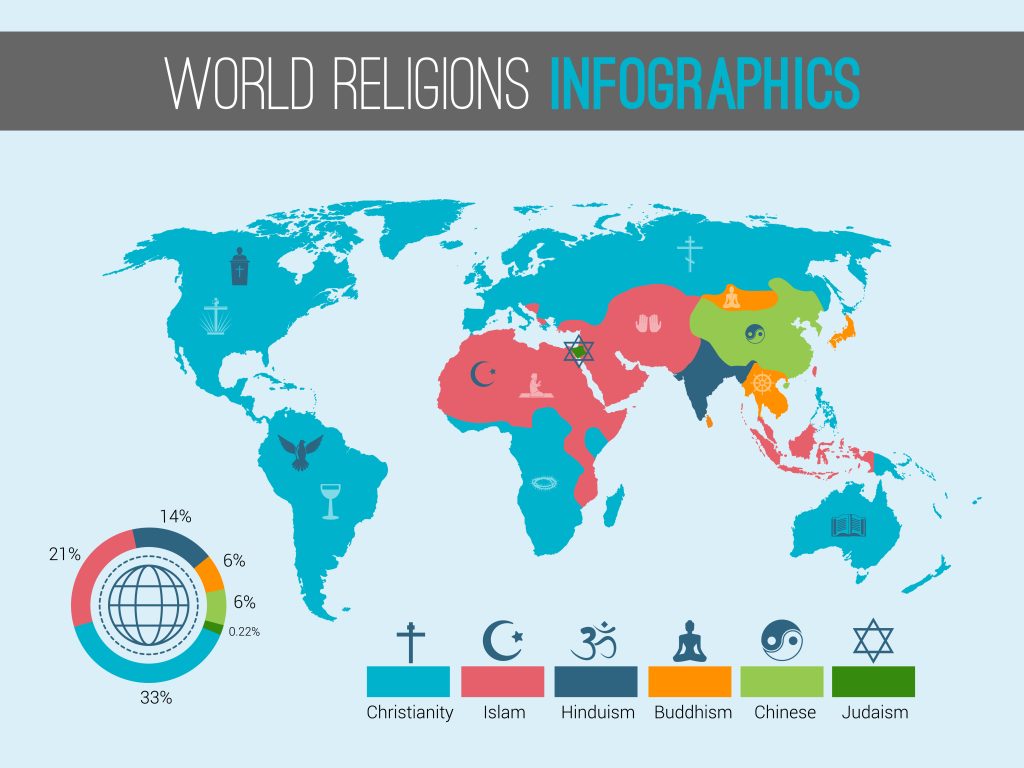
The concept of the 'Islamic World' represents a unique phenomenon in the landscape of global religions. While terms like 'Christian World' or 'Catholic World' are rarely used, and there are no equivalent expressions such as 'Hindu World' or 'Buddhist World', the idea of an Islamic World is widely recognized and accepted. This term, which is written with capital letters, emphasizes its importance and recognition as a standard.
The Islamic World (in Arabic العالم الإسلامي, al-‘Alamul Islami; in English: Islamic World) is a terminology that takes on different meanings. Culturally, it refers to the community of Muslims around the world, regardless of whether they live in Islamic countries or not and whether they are a majority or a minority. This global community, also known as 'ummah', currently counts about 1.5 billion people and, according to the Pew Research Center, will almost double in the next thirty years, surpassing the followers of any other religion.
The ummah is not a monolithic entity, but rather a collection of ethnicities and nations united by the Islamic faith. Contrary to what Elie Kedourie stated in his book “Democracy and Arab Political Culture” (1992), the ummah is not limited to the Muslims of the Arab World. Islam promotes unity among Muslims globally, a concept that has given rise to the ideology of 'pan-Islamism', profoundly influencing the Islamic World.
From a historical and geopolitical perspective, the term Islamic World often refers to countries with a Muslim majority or those where Islam plays a significant role in politics. However, the Islamic World is not a unitary entity, but rather an aggregate of nation-states with predominantly Muslim populations.
The fundamental question is whether there really exists an Islamic World understood as a unified entity. If the Islamic World is considered synonymous with unity among Muslim countries, then it must be recognized that it does not exist in practice. Instead, there exists a set of nation-states with Muslim majorities, which historically have shown greater cohesion and solidarity during the era of colonialism and Western imperialism. An example of such solidarity is the immediate recognition of Indonesian independence, proclaimed on August 17, 1945, by other Islamic countries such as Egypt, Syria, and Lebanon.
Not Just a Name: The Islamic World and Its Organizations
The concept of the 'Islamic World' goes beyond the simple definition of a phenomenon or a name. There exists a state entity called the Organization of Islamic Cooperation (OIC), which promotes cooperation among Muslim countries. Initially known as the Organization of Islamic Conference, this institution was founded during an Islamic Conference in Rabat, Morocco, in September 1969. Its general secretariat is located in Jeddah, Saudi Arabia, and its main objective is to provide assistance to less developed Muslim countries and support to Muslim minorities in non-Muslim countries, who often face challenges related to Islamophobia.
The OIC, which has 57 member countries, is led by a Secretary General. At the same time, there is also the Rābiṭat al-ʿĀlam al-ʾIslāmī, or World Muslim League, a non-state organization based in the holy city of Mecca. Currently led by Sheikh Mohammed bin Abdulkarim Al-Issa, former Minister of Justice of Saudi Arabia, this organization plays a significant role in the global Islamic landscape.
The task of both organizations is complex, especially considering the turmoil that characterizes the Islamic World, particularly the Arab World. Relations between Islamic countries are often marked by political tensions and conflicts. Despite the suffering of the Palestinian people and other urgent issues such as those of the Kurds, the Rohingya, Kashmir, and the Uighurs, the concrete unity of the Islamic World seems to be lacking, limited to political support and symbolic assistance.
Problems and Perspectives in the Islamic World
The challenges faced by organizations in the Islamic World, such as the Organization of Islamic Cooperation (OIC) and the Rabithah Alam Islami, are complex and far-reaching. These institutions often find themselves having to manage difficult political and social situations, with a role that sometimes is limited to providing rhetorical political support and prayers, without being able to exert a concrete and tangible influence.
An example of this difficulty is the case of the Bosnian and Kosovar nations, which have received greater aid and protection from Western countries, particularly from NATO and the United States, rather than from the Islamic World. This highlights a lack of cohesion and effective action on the part of Islamic organizations.
The OIC, in particular, has shown signs of weakness, as highlighted by the controversies that arose during the OIC Summit in Kuala Lumpur in 2019. At the same time, the Muslim League seems less influential and active than one would expect. This scenario suggests that the solidarity of the Islamic World does not meet the expectations of Muslims around the globe.
Nevertheless, it is important to recognize that the OIC and the Muslim League play a significant role and carry considerable weight. However, the perception that their activities are sporadic or ineffective may be due to a lack of publication and dissemination of their initiatives, especially in social, educational, and cultural fields.
At the political level, managing a multilateral organization with 57 member countries is a complex task. Each country has its own national interests, which often take precedence over the common goals of unity and solidarity among Muslim countries. This makes it difficult for the OIC and the Muslim League to achieve coordinated and unified action.
The criticism of Fazlur Rahman, which highlights the decline of the spirit of unity among Muslim countries, may seem dramatic, but it reflects a reality in which national interests dominate international relations and foreign policy. However, it is essential to continue working to strengthen cooperation and solidarity in the Islamic World, seeking ways to overcome divisions and promote more effective common action.
What to Expect?
The question that many ask is whether the Islamic World really exists or if it is just a virtual concept. For pessimists, it may seem like a virtual entity, but for optimists, the existence of organizations like the OIC and the Muslim League represents a positive element. Indonesia, as the largest Muslim nation in the world, has the potential to lead concrete initiatives that promote cooperation and realize the teachings of Islam as rahmatan lil ‘alamin (a mercy for the universe).
Indonesia can play a pioneering role in promoting democracy, human rights, and social progress in the Islamic World, helping to transform the OIC and the Muslim League into more active and operational organizations. By focusing on non-political sectors, these organizations could strengthen their presence and influence, promoting unity and collaboration among Muslims worldwide.
Yusuf Daud
Founder SophiaCitra Institute PhiloSufi centre for Interfaith and Intercultural dialogue Surabaya-Indonesia