

Discovering Oneself: The Path of Spiritual Transformation in Islam

European strategic autonomy: why international law is no longer enough
January 10, 2026
Remembering Shaykh Habib Omar ibn Hamid al-Jilani: A Revered Master of the Umma
January 25, 2026
Self-inquiry is a process of deep introspection grounded in the most authentic Islamic tradition—not as a doctrinal imposition, but as a universal call addressed to all human beings, regardless of religious, social, racial, political, or economic background. This call carries a fundamental exhortation: to return to one’s spiritual roots and to discover one’s true essence in the light of divine guidance.
In the Qur'an, the Arabic term muḥāsabah, meaning “reckoning” or “self-accounting,” represents the core of this spiritual process. Allah invites believers to turn their gaze inward: the Prophet Muhammad, peace and blessings be upon him, underscored the importance of this practice when he said, “Let us hold ourselves accountable before we are held accountable on the Day of Judgment.” This is not merely a moral admonition; rather, it constitutes the foundation of individual responsibility (amānah) that Allah has entrusted to every soul.
Unlike materialist conceptions that locate salvation and truth exclusively in the external world, Islam invites believers to undertake a conscious path of inner inquiry—one that transcends conventional dogmatic teachings and is grounded in the individual’s direct and personal relationship with the Divine. This quest is not an invitation to turn toward external sanctuaries, although these possess their own spiritual significance; rather, it is a call to discover that dwelling of the Divine that resides within one’s own heart—the Qur’an describes it as the “qalb al-Mu’min,” the heart of the believer.
The Essential Conditions of Authentic Spiritual Research
To embark authentically upon the path of profound self-reflection as taught within the Islamic tradition, it is necessary to establish specific preliminary conditions rooted in the purity of intention (niyyah). The most common mistake individuals make is to approach this quest with a mind already burdened by entrenched cultural prejudices and, even more critically, without having purified their intention of the pursuit of selfish gain.
The Prophet Muhammad, peace and blessings be upon him, taught: “Actions are judged by intentions, and each person will have what they intended.” The believer must come before oneself with a mind and heart fully open, disposed toward spiritual humility (khushu‘) and the sincere pursuit of truth.
The Qur’an emphasizes: “Indeed, those who deny Our signs and are arrogant toward them—the gates of Heaven will not be opened for them, nor will they enter Paradise until the camel passes through the eye of a needle” [Sūrat al-A‘rāf 7:40].
This arrogance also includes the arrogance of believing that one already knows oneself. The only legitimate approach is to enter one’s inner universe with complete receptivity, recognizing that “there is nothing like unto Him” [Sura ash-Shûrâ 42:11]—including our inability to know ourselves fully without the Divine Light.
Mindful Meditation as the Islamic Practice of Tafakkur
The process of turning inward—exploring the depths of one’s consciousness with the intention of spiritual purification—is deeply rooted in the Islamic tradition under the term tafakkur—the mindful contemplation of Allah’s signs. Unlike superficial understandings of meditation, Islamic tafakkur is not an exercise in emptying the mind or escaping reality; rather, it constitutes a rigorous inquiry into the relationship between the individual soul and the Divine.
The Qur’an repeatedly invites believers to engage in this practice: “Indeed, in the creation of the heavens and the earth, and in the alternation of night and day, there are signs for those endowed with intellect” [Sura al-‘Imrân 3:190]. The Prophet Muhammad devoted long hours to mindful reflection in the Cave of Hira before receiving revelation—a practice that Islamic scholars identify as the highest form of tafakkur. No complex formulas were required, no elaborate rituals were necessary: only the sincere intention to seek the truth was required. Imam al-Ghazali underscored the crucial importance of this practice in his masterpiece “Ihya’ ‘Ulum al-Din,” describing tafakkur as the means through which the soul attains higher levels of spiritual awareness.
A Widespread Misunderstanding: Exploitation of Spiritual Pursuit
In recent decades, the practice of spiritual contemplation has been progressively distorted—from a means of inner purification into a therapeutic technique aimed at achieving tangible, measurable benefits. Many approach the Qur’an and the Sunnah with the explicit intention of improving their mental health, attaining emotional balance, or securing material prosperity. Although such outcomes may occur as side effects of a genuine practice of faith, turning them into primary goals reflects a fundamental misunderstanding of the nature of Islam.
The Qur’an issues a clear warning: “Those who desire the present life and its adornments—We shall fully repay them for their deeds therein” [Sura Hud 11:15]. Prioritizing such worldly gains constitutes a form of distraction from the ultimate purpose of existence. When one turns to spiritual practice with the instrumental intention of healing oneself, one implicitly assumes that one already knows one’s true spiritual condition. As the eminent scholar Ibn Qayyim al-Jawziyyah observed, this presumption of knowledge constitutes a considerable obstacle to genuine spiritual transformation. The true search for the self must be undertaken with the sole intention of obeying the divine command to self-examination and purification, without expecting immediate rewards.
Encountering One's Spiritual Reality
What encounters await an individual who sincerely dedicates themselves to the path of deep introspection inspired by the Qur'an and the Sunnah?
The answer is both uplifting and terrifying: one will encounter oneself in their spiritual entirety, in all manifestations of the soul—what Islam refers to as “nafs.”
Islam teaches that the soul passes through successive stages of spiritual development. There is the “nafs al-ammārah”—the soul that incites to evil, continually inclining one toward selfishness, lust, and violence. There is the “nafs al-lawwāmah”—the self-reproaching soul, aware of its departure from rectitude. And there is the “nafs al-muṭma’innah”—the tranquil, conscious soul, one that has attained spiritual peace through sincere submission to Allah.
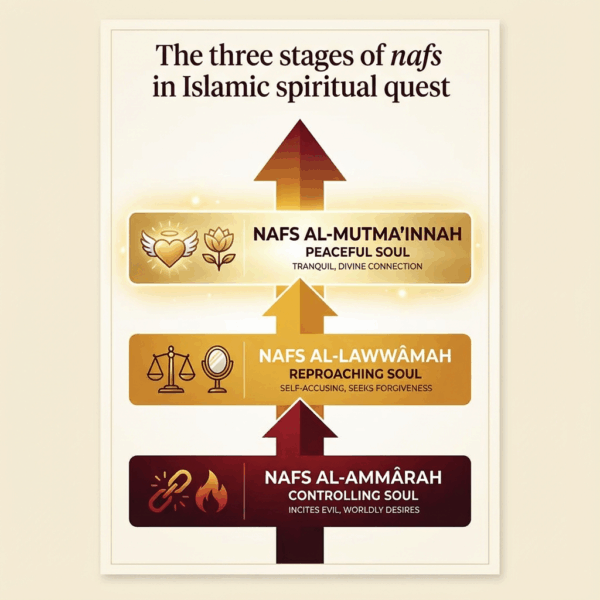
Discovering Oneself: Diagram of the Three Stages of the nafs
The Dual Task of Islamic Transformation
The authentic search for the self entails two complementary and inseparable dimensions. The first consists in uncovering one’s true nature—not an abstract metaphysical essence, but the concrete reality of one’s soul in the present moment, with all its weaknesses, its contradictory desires, and its capacity for both evil and good. The second concerns what the Qur’an calls “tawbah”—a conscious return and transformation. Having undertaken the arduous path of self-examination, the individual then stands before a choice of decisive importance: to commit sincerely to the process of transformation toward the good, shaping one’s present disposition in accordance with the elevated values taught by the Qur’an and by the example of the Prophet Muhammad.
The Qur’an declares: “O you who believe! Turn to Allah in sincere repentance: it may be that your Lord will absolve you of your sins and admit you into Gardens beneath which rivers flow” [Sura at-Tahrim 66:8]. This call is continually renewed, indicating that transformation is not a one-time event but an ongoing process of renewing one’s intention and practice.
The Contemporary Crisis of Spiritual Awareness
In our time, there is a tragic neglect of truly living these Qur’anic principles. Although billions of people recite the words of the Qur’an every day, the vast majority do not embark upon the concrete path of deep self-reflection that those words demand. The central problem lies not only in external factors—social or political arrangements, or deficiencies in healthcare systems—but rather in our collective negligence in practicing rigorous moral and spiritual self-assessment.
As the Qur’an teaches, Allah does not change the condition of a people until they change what is within themselves. This means that the primary responsibility for social transformation lies in individual spiritual transformation. This truth becomes all the more urgent as the contemporary crises we face intensify. Every ill we observe in the fabric of our community—every act of violence, every moral malady, every neglect of justice—is directly related to deficiencies in our spiritual awareness and to the compromises we make to our integrity.
The Weight of Personal Responsibility in Islam
The Prophet Muhammad—peace and blessings be upon him—said: “Each of you is a shepherd, and each of you will be questioned about his flock.” This teaching conveys that moral responsibility cannot be delegated. Every individual, in the position they occupy and with the influence they possess, is accountable for the good they could have done but did not do. Islam rejects any dichotomy between personal and collective responsibility.
In Sura al-‘Alaq, Allah reveals to the Prophet: “Read! In the name of your Lord who created—created man from a clinging clot. Read! And your Lord is the Most Generous, who taught by the pen, taught man what he did not know” [Sura al-‘Alaq 96:1–5].
This call to “read”—understood by scholars as an exhortation to reflect, to comprehend, and to transform oneself—is addressed not only to a single individual, but to all of humanity. It is an invitation to read oneself, to understand one’s place in the cosmos, and to assume full responsibility for that understanding in one’s daily conduct.
Conclusion: A Renewed Appeal
The authentic search for the self, as understood in Islam, is not a narcissistic exercise in self-inquiry detached from the world. Rather, it is the foundation upon which a life of integrity, awareness, and responsibility is built. When an individual sincerely commits to this path—when one ceases to seek excuses or rationalizations for one’s shortcomings, and stands before the Divine and oneself with complete transparency—something profound occurs. The reality of one’s soul ceases to be a haze and becomes luminous.
And in that luminosity, one discovers both one’s weakness and one’s capacity for growth. One discovers that change is possible—that transformation is not merely an abstract ideal, but a practical and concrete reality. For Allah has promised that His mercy surpasses His wrath, and that for the one who turns to Him with sincerity, the doors of redemption remain eternally open.
O Lord, help us to know ourselves and to become aware of our true nature, so that we may return to You in sincere repentance and live in accordance with Your Will and Your Mercy. Amen, amen.
Amira Badraoui